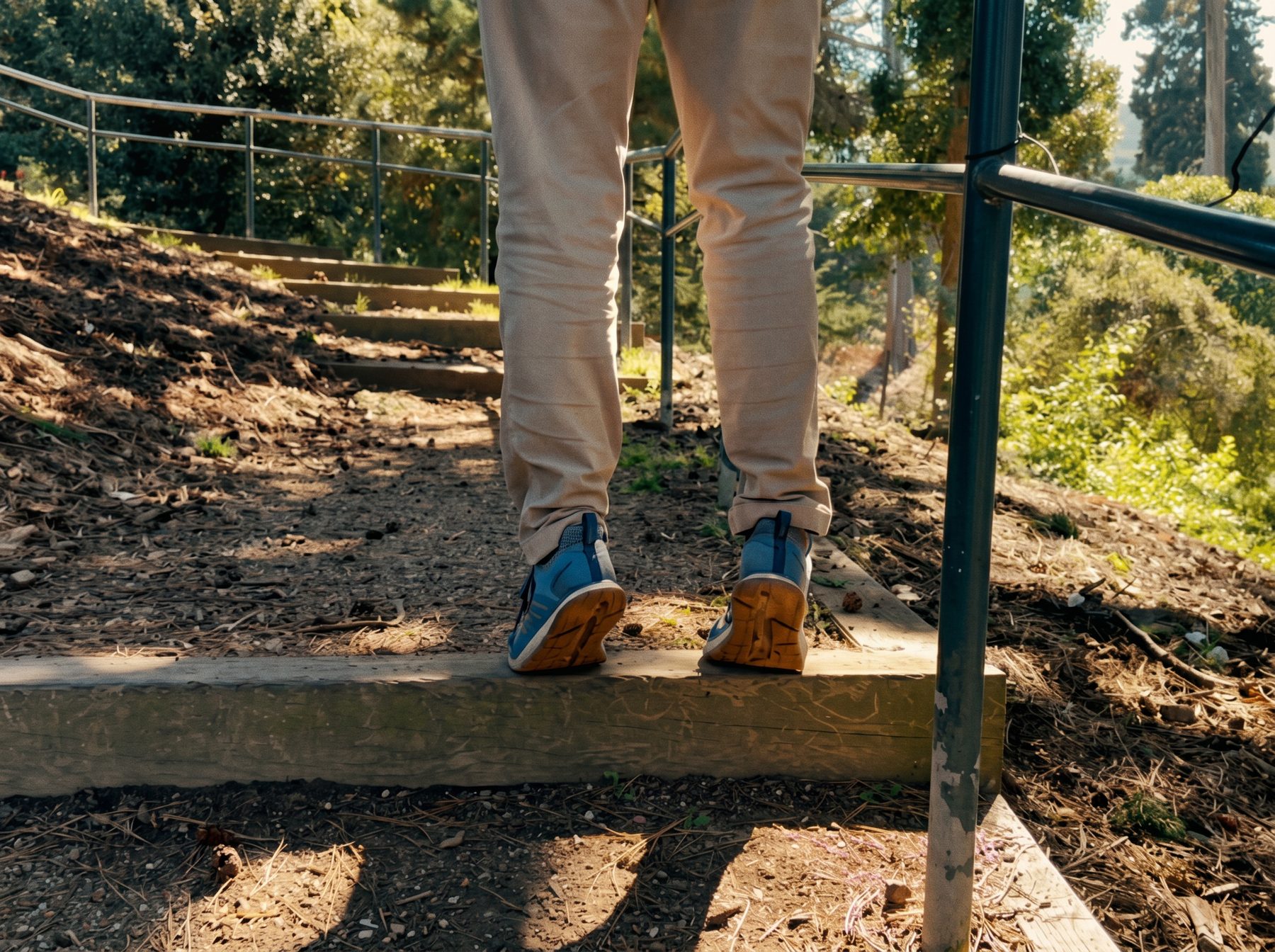
Drop your heel off a curb sometime. Just let it hang. You'll immediately notice how much range of motion you don't have down there. That tightness in your Achilles, that stiffness through your ankle and calf, has been building for years, and you've probably just gotten used to it.
There are 26 bones in each foot. They're supposed to move, articulate, adapt. But flat surfaces, flat shoes, and the same walking pattern day after day cause your Achilles to shorten, harden, and develop adhesions. The heel gets stuck. The calf locks up around it. And that stiffness doesn't stay local. It sends a ripple effect up through your knees, your hips, your back, your whole body.
That's the problem most people are walking around with and don't realize it. The bottom of your body feels stuck when it should feel buoyant and free.
You've probably done the classic calf stretch: foot on a step, heel hanging off the edge, hold for thirty seconds. Maybe you've foam rolled. Maybe you've had someone dig their thumbs into your calves. And it felt better for an hour, maybe a day. Then it came right back.
Here's the issue: a static stretch doesn't recondition anything. It temporarily lengthens tissue that snaps right back because the underlying pattern hasn't changed. Your Achilles tendon isn't tight so much as it's lost its elasticity. It should feel like a thick coiled spring. Instead it feels like a rigid cable.
And if you have plantar fasciitis, this is almost certainly where it's coming from. Your plantar fascia connects from your heel bone to your toes. When the Achilles is short and stiff, it pulls on that heel bone and tightens the entire bottom of your foot. Treating the foot without addressing the Achilles treats the symptom, not the source.
I think about the spring step like hanging for the lower body. Hanging decompresses your spine by letting gravity create space. The spring step does the same thing for your Achilles, your calf muscles, and all the connective tissue around your ankle.
But there's more to it than decompression. The spring step turns what most people know as a static hold into a dynamic movement. You're conditioning the Achilles tendon to regain its spring-like quality, combining flexibility with strength in the same motion. You're smoothing out adhesions, like a pestle and mortar, until everything moves freely again.
The spring step lets gravity create space in your Achilles, your calf muscles, and the connective tissue around your ankle, the same way hanging decompresses the spine from above.
You're conditioning the Achilles to regain its spring-like quality instead of just lengthening it temporarily. That's what a static stretch never gets to.
There's also a circulatory component that most people don't think about. Your heels represent what I call the lymph pump. That bouncing motion pumps blood back up to the heart, moves lymphatic fluid, gets nerve flow going. You're doing more than loosening a tight muscle. You're moving energy through the whole lower body.
And that's what makes this a full body reset rather than a calf protocol. Clients tell me their shoulder blades start to relax while they're doing it. Their whole back opens up. The whole body starts to settle and let go because the foundation is finally moving the way it's supposed to.
I cleared my own plantar fasciitis with the spring step. I'm just going to say that plainly. I also had ankle pain after a surgery that wouldn't go away. The joint had gotten stiff, scar tissue had built up, and nothing was releasing it. What I needed was function. The spring step gave me that.
With clients, I see the same pattern. People come in with chronic Achilles stiffness, that crackling sensation when they rotate their ankle, plantar fasciitis that's been hanging on for months or years. Within the first few sessions of learning the spring step, they start reporting that the crackling is gone. The stiffness in the morning is better. Their calves feel lighter. They describe it as getting their bounce back, which is exactly what's happening. The Achilles is becoming a spring again instead of a cable.
I cleared my own plantar fasciitis with the spring step.Garrett
When I'm running in the park and my legs start to feel fatigued, I'll find a curb, do the spring step for a couple of minutes, and my legs feel completely different afterward. It's a useful tool to have because you can do it anywhere. But doing it correctly, with the right positioning and rhythm, is what makes the difference between a stretch that does nothing and a movement that changes your tissue.
The spring step looks simple. That's part of what makes it powerful. Once you know it, you can do it on any step or curb for the rest of your life. But the difference between doing it right and doing a basic calf stretch is everything.
Foot placement matters. The rhythm matters. How you hold your body while you move matters. If you're leaning forward or rounding your chest, you lose the full-body effect entirely. There's a specific way to find your range of motion and progress from there, and it's different for everyone depending on how locked up their Achilles and ankles are.
The people who get the most out of this protocol are the ones who learned the feeling first, before the form. That's what a session gives you: the experience of what it's supposed to feel like when it's working, so you can replicate it on your own every day after that.
If your Achilles feels more like a cable than a spring, we can help. See how the Amari Method finds the pattern behind it.
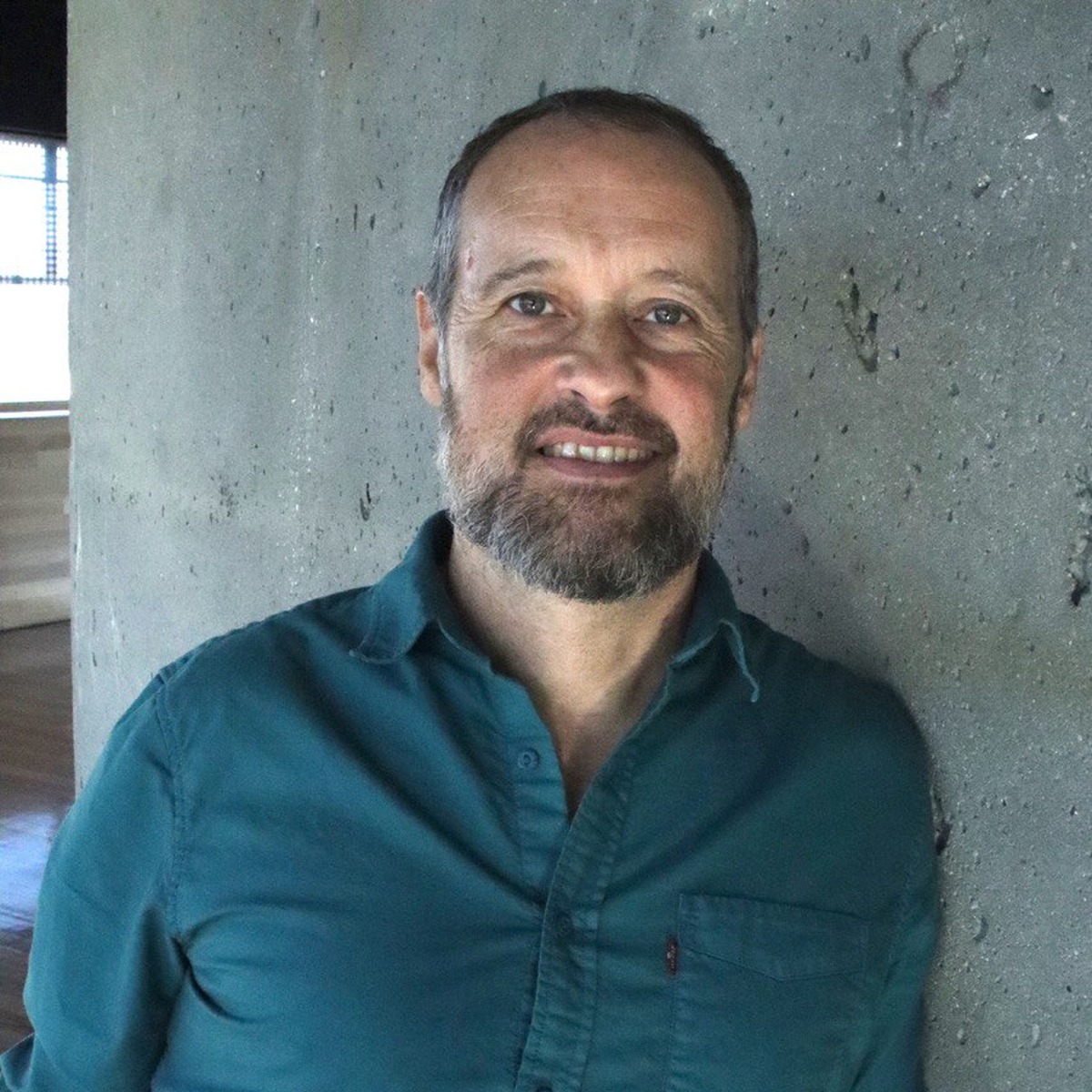
Garrett has spent 25+ years in hands-on practice. He built the Amari Method after using its own protocols to resolve his own carpal tunnel and plantar fasciitis.
Book a session with Garrett. If you don't experience noticeable relief, we keep working with you until you do, at no additional charge.
$29 · Amari Assessment · 50 minutes · San Francisco