One of my mentors used to say most people wear their shoulders as earrings. He was right. Look around any office, any subway car, any dinner table: shoulders hiked up, necks tight, upper backs locked in a chronic holding pattern that nobody even notices anymore. That tension has been there so long it just feels normal.
But it's not normal. It's your body stuck in a defense posture, sympathetic, fight-or-flight, everything lifted and contracted. And all that tension is compressing your spine from the top down, all day, every day.
The vertical drop is one of the protocols I teach that directly reverses that pattern. It gives every muscle from the top of your skull down through your neck, your entire spine, and all the muscles in your back a chance to do something they may not have done in years: actually let go.
Gravity never stops. Every second you're upright, it's pulling down on your spine, compressing your discs, pressing your vertebrae together, tightening the ligaments and muscles that run the length of your back. Now add sitting for eight, ten, twelve hours a day. The compression becomes relentless.
Your body adapts to this the only way it knows how: by bracing. Your back muscles lock up. Your shoulders climb toward your ears and stay there. Your neck stiffens. This isn't a muscle problem in the traditional sense. It's a pattern. Your whole upper body has shifted into a state where everything is working too hard, all the time.
That pattern causes more than back pain. It cascades: neck tension, shoulder dysfunction, headaches, restricted breathing, all downstream effects of a spine that never gets a chance to decompress.
Most solutions try to force the spine open. Traction devices pull on you. Inversion tables flip you upside down. But none of them address the underlying pattern: why your body is compressing in the first place.
The concept behind the vertical drop sounds almost too simple, but once you understand the anatomy, it's pretty elegant.
Your skeleton has two main parts. Your axial skeleton is your head, your entire spinal column, and your rib cage. Your appendicular skeleton is your arms, legs, and pelvis. In the vertical drop, we use the appendicular skeleton to create a rigid frame, like scaffolding, so the axial skeleton can just drop into it.
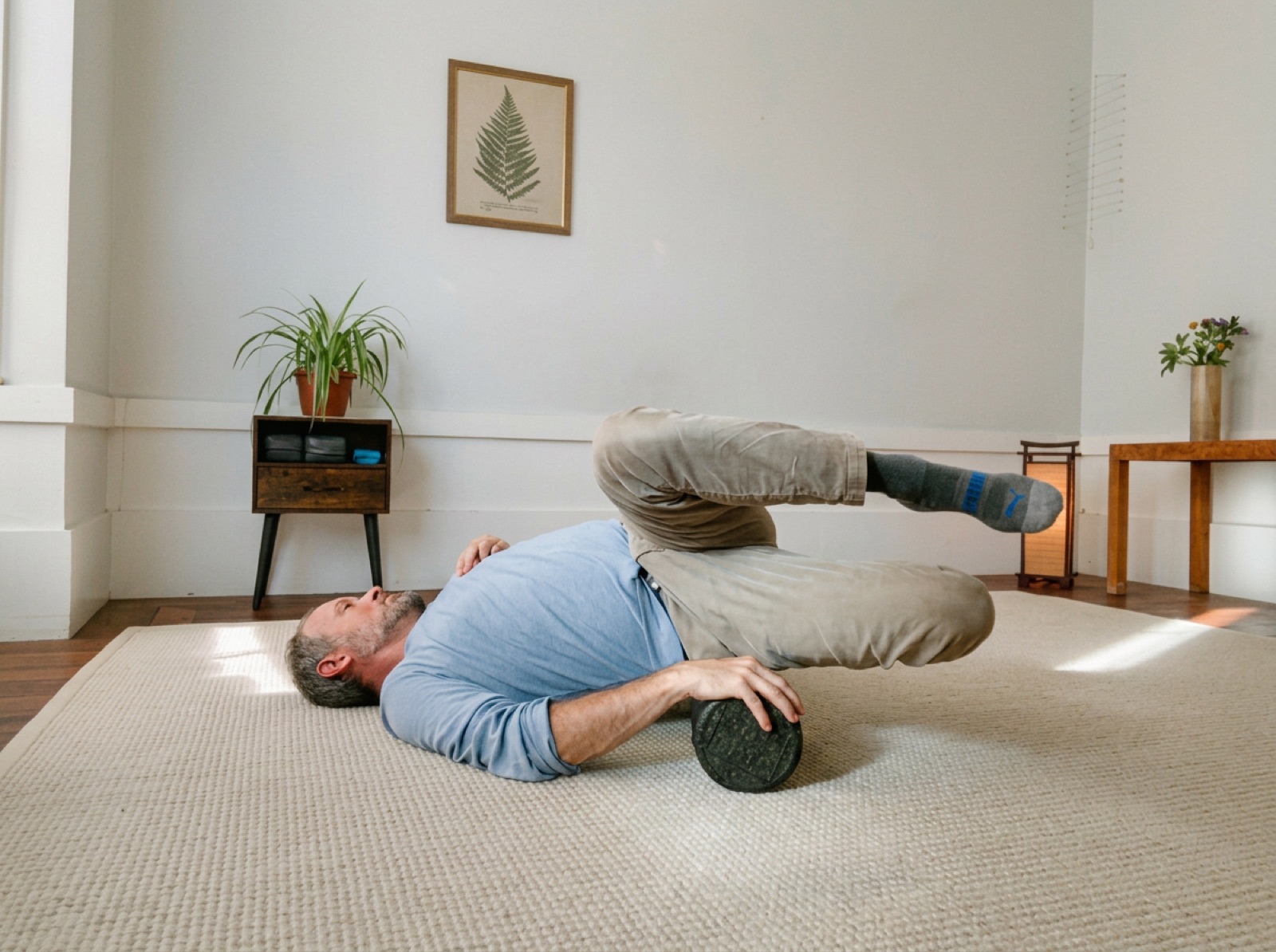
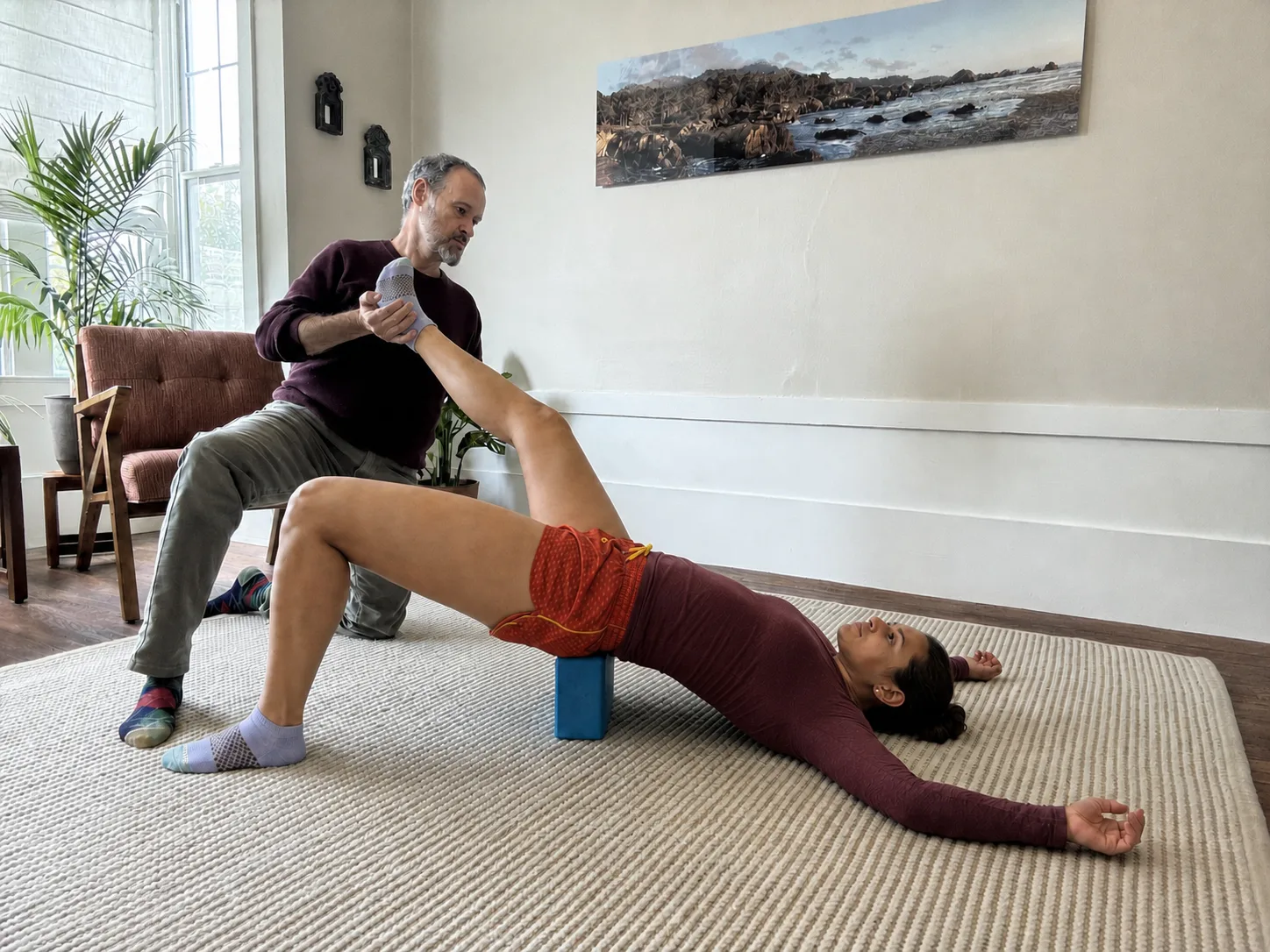
Your arms, legs, and pelvis create a rigid frame that holds you up, so the muscles that normally lift and brace don't have to do that job anymore.
Your head, spine, and rib cage release into the frame. Muscles that have been working overtime for years suddenly get permission to stop, and everything melts from the top down.
Think of it as creating the negative picture of how you normally hold yourself. Instead of your muscles habitually lifting and contracting and bracing, the structure of the protocol flips that completely. When muscles that have been working overtime for years suddenly get permission to stop working, something remarkable happens. Everything melts, from the top down.
The muscles in your neck start to release. Your shoulders drop away from your ears, maybe for the first time in years. Your upper back, your mid-back, all those small muscles along your spine that have been locked in contraction start to let go. Your vertebrae, jammed together under all that compression, finally have space between them.
The first time people do this, it's a little unusual. It's not a movement pattern anyone's familiar with, and it takes a minute for your body to trust it. But when it clicks, when your body understands that the scaffolding is holding you and you can actually release, the feeling is unmistakable.
People describe their spine lengthening in real time. That constant pressure between the vertebrae just opens up. Breathing gets easier because the thoracic spine isn't locked down anymore. Shoulders that haven't truly relaxed in years finally stop holding.
I've been doing this for over fifteen years now, and when I do a vertical drop, almost every vertebra in my mid-back adjusts itself. No outside adjustment, no cracking table, just gravity and space and my body's own intelligence doing what it already knows how to do when you give it the opportunity.
Your vertebrae want to realign. Your muscles want to release. Your spine wants to decompress.Garrett
That's the thing people don't expect. The vertical drop doesn't force anything. It just creates the conditions where your body can finally do what it's been trying to do all along.
People sometimes hear decompression and think stretching. It's not. Passive stretching might lengthen a muscle temporarily, but it doesn't create actual space in your vertebral joints. It doesn't retrain the holding pattern that's causing the compression.
The vertical drop works on a different level. Things that are working too hard start to relax. Things that aren't working enough start to work more. The protocol retrains your whole upper body, shifting it out of that chronic contraction and into something more balanced.
And because it's your body doing the work, not a machine, not someone else's hands, the changes tend to stick. The more consistently you practice, the faster your body responds. What might take a minute or two at first eventually happens in seconds, because your nervous system learns the pattern.
The vertical drop looks simple. Conceptually, it is simple. But the details of how you set it up matter enormously, and the most common mistake people make eliminates the decompression effect without them even realizing it. It turns a spinal decompression protocol into something else entirely.
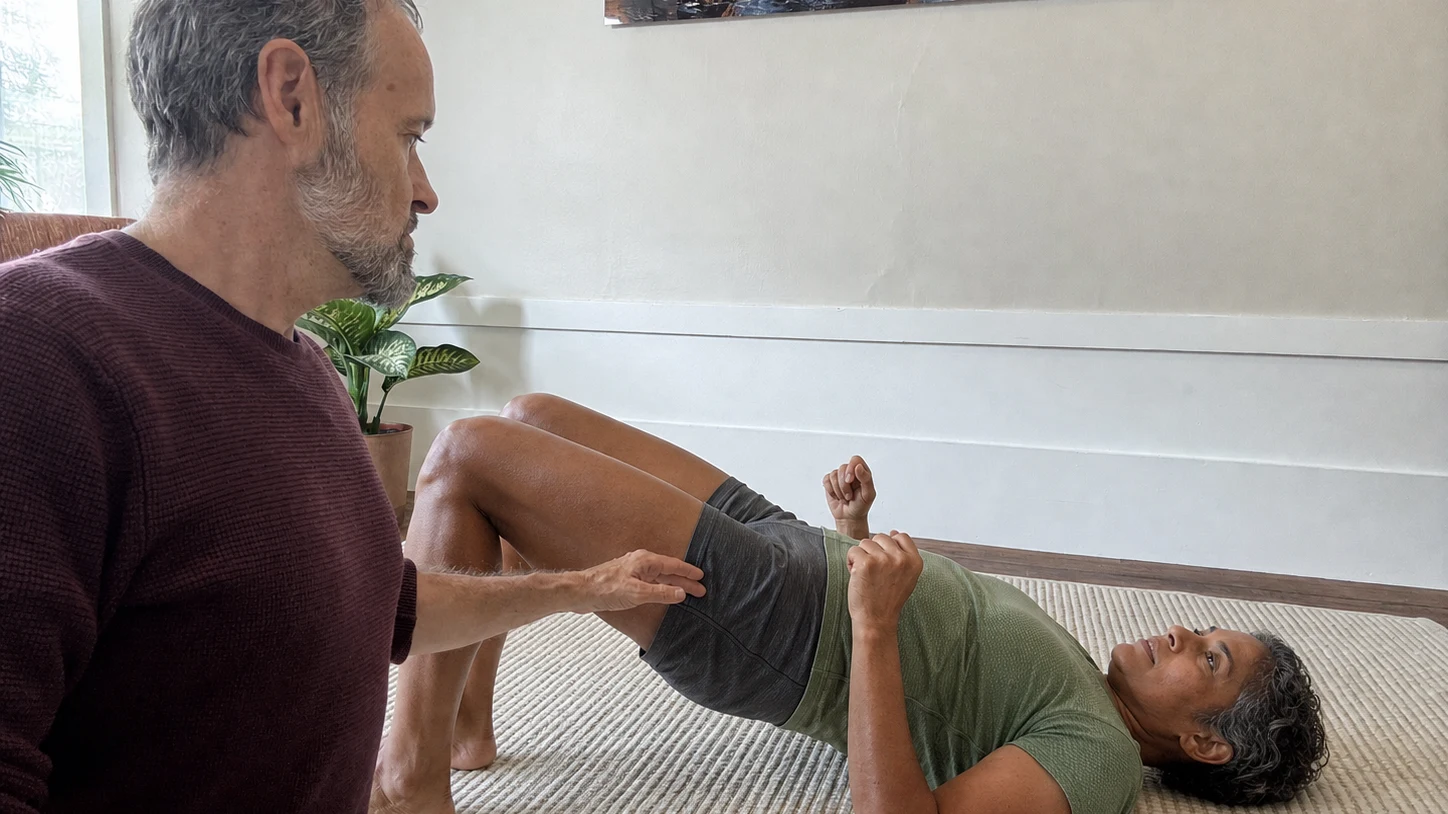
This is one of those protocols where having someone watch you do it and correct what you can't feel yet makes the difference between not getting what the big deal is and realizing your back could feel like that. Your body needs to learn what the correct position feels like, and that's hard to do from a description alone.
The vertical drop is also part of a larger system. It works alongside other protocols that address different aspects of the same imbalances: your posterior chain, your hands, your postural foundation. If the vertical drop isn't the right starting point for your body right now, there are other entry points that might be.
If your shoulders live up near your ears no matter how much you try to relax, we can help. See how the Amari Method finds the pattern behind it.

Garrett has spent 25+ years in hands-on practice. He built the Amari Method after using its own protocols to resolve his own carpal tunnel and plantar fasciitis.
Book a session with Garrett. If you don't experience noticeable relief, we keep working with you until you do, at no additional charge.
$29 · Amari Assessment · 50 minutes · San Francisco